For Gulf-based principals & CFOs
A measured approach to relocating your trading business to Singapore
A practitioner’s guide for commodity traders, family offices, and treasury operations evaluating Singapore as a primary or secondary base.
Across the Gulf, principals are revisiting questions of jurisdictional diversification. Pillar Two has narrowed the historical tax differential between leading hubs. Family offices and trading houses are increasingly maintaining capability in more than one centre. Singapore — with the deepest commodity trading ecosystem in Asia, an actively-managed incentive architecture, and a stable rule-of-law environment — has become the most frequently considered destination. This guide sets out, in practitioner detail, how the move is structured, what it costs, and the outcomes a well-prepared firm can expect.
Claim The Full Report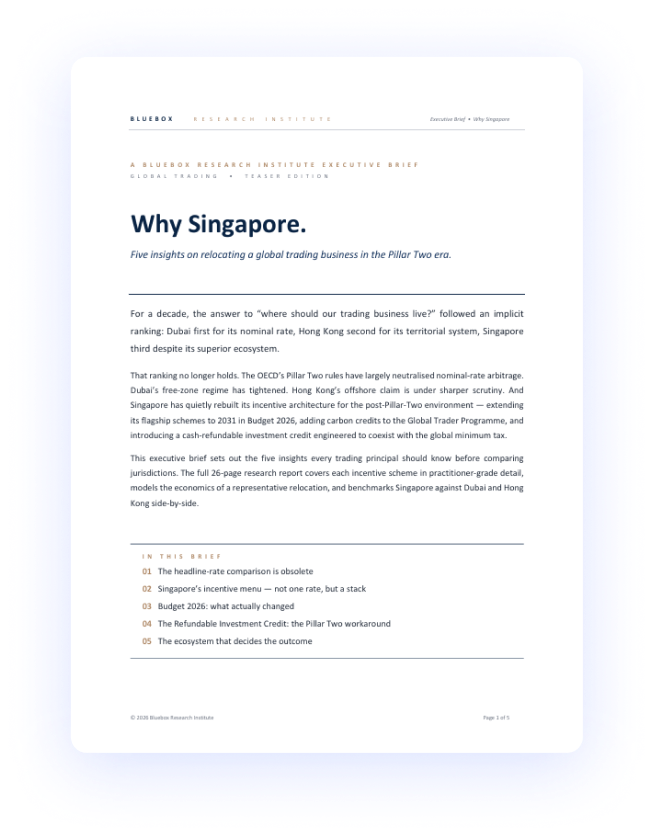
The summary
The case for Singapore is now structural, not opportunistic
Three developments have reshaped the relocation calculus for Gulf-based trading firms and family offices.
The reassessment
Three reasons principals are reopening the question in 2026.
The factors driving renewed interest in Singapore are well-defined, structural, and visible on every CFO’s dashboard.
Pillar Two has compressed the tax differential
For multinational groups with consolidated revenue above €750 million, the UAE’s 15% Domestic Minimum Top-up Tax — effective from financial years beginning 1 January 2025 — has eliminated the practical advantage of free-zone 0% status.
A well-structured Singapore group, by contrast, can combine GTP, DEI-IHQ, FTC, and the Refundable Investment Credit to land at a 5–10% blended effective rate while remaining Pillar Two compliant. The arithmetic has shifted decisively.
Diversification is becoming the default
Single-jurisdiction concentration is increasingly viewed as a governance question rather than a tax-optimisation question. Family offices and trading principals across the Gulf are maintaining capability in more than one centre — typically the home jurisdiction plus Singapore.
Singapore’s combination of political stability, deep banking, treaty network of approximately 100 DTAs, and English common law makes it the most frequently chosen second base for groups headquartered in the GCC.
Singapore has actively Modernized its offer
Budget 2024 introduced the Refundable Investment Credit, gazetted in November 2024 — a Qualified Refundable Tax Credit under OECD rules that offsets Pillar Two top-up without breaching the GloBE effective-rate floor.
Budgets 2025 and 2026 extended GTP and FTC through 2031, broadened the withholding-tax exemption to twelve categories of interest-like costs, and added Environmental Attribute Certificates to the qualifying commodities list. The architecture is being deliberately maintained.
Secure Your Trading Future Today
See why Singapore is emerging as the top destination for stability, infrastructure, and growth.
View Full ReportThe incentive architecture
Four programmes that, used in combination, define the Singapore offer.
Singapore does not compete on a single headline rate. It offers a calibrated set of negotiated incentives. A well-prepared firm typically secures three or four in combination.
01 • Enterprise Singapore
Global Trader Programme
5–15%
Concessionary rate on qualifying trading income
The principal incentive for international commodity traders. Covers physical trading, brokering, derivatives, and structured commodity financing across energy, metals, minerals, agricultural commodities and — from February 2026 — environmental attributes. Extended in Budget 2026 to 31 December 2031.
Typical commitments: US$100m+ annual qualifying turnover, S$3m+ annual local spend, three or more qualifying trading professionals based in Singapore.
02 • Economic Development Board
DEI-IHQ Headquarters Award
5–15%
On incremental headquarters-service income
The consolidated successor to the former Regional Headquarters Award and International Headquarters Award. Designed for groups establishing genuine strategic, finance, tax, treasury, HR, IT, and legal leadership functions in Singapore.
Typical applicant: trading or industrial group consolidating group oversight and shared services in Singapore.
03 • Economic Development Board
Finance & Treasury Centre
8–15%
Plus withholding-tax exemption on twelve types of interest
Essential for capital-intensive trading. Qualifying treasury income taxed at 8% or 10%, with a 15% tier available for Pillar Two MNEs. Budget 2026 extended FTC to 2031 and broadened the withholding exemption to cover guarantee fees, arrangement fees, commitment fees, and related borrowing costs.
Typical applicant: group with US$500m+ revolving credit facilities, active hedging, and intra-group lending arrangements.
04 • EDB / Enterprise Singapore
Refundable Investment Credit
Up to 50%
Cash-refundable credit on qualifying spend
Singapore’s Pillar Two-compatible centrepiece. Designed as an OECD Qualified Refundable Tax Credit — treated as income rather than as a rate reduction. Does not pull the GloBE effective rate below 15%; does not trigger top-up. Cash-refundable within four years.
Typical applicant: Pillar Two MNEs investing in expansion. Commodity trading firm setup and expansion is an explicitly qualifying activity.
Side by side
Singapore and the UAE: a current comparison.
An updated view of the two jurisdictions for trading firms and headquarters operations, on the dimensions that determine outcome.
Don’t Wait for the Next Shock
Access a data-backed guide to relocating your commodity trading business with confidence.
View Full Report
Worked scenario
A representative case, modelled.
A mid-to-large trading group: US$1.5 billion global revenue, Pillar Two in-scope, currently operating from a UAE free zone, considering a primary relocation to Singapore.
The full report walks through the substance requirements, group structure, and EDB / Enterprise Singapore negotiation sequence behind this model.
The process
How a Singapore relocation is sequenced.
Six phases, typically nine to eighteen months end-to-end for a mid-to-large trading group.
About the Institute
Independent research. Senior practitioners. Discretion by default.
Bluebox Research Institute is an independent research firm focused on cross-border commerce, jurisdictional structure, and the operating environments that host the global trading community. Our team combines senior commodity trading, tax, treasury, and legal practitioners who have executed the incentive applications, agency negotiations, and operational relocations described on this page.
We do not sell audit, legal, or tax-preparation services. Our research is published without conflict. When a relocation requires specialist execution, we introduce the appropriate Big Four, magic-circle, or boutique firm for each workstream.
Independent
No audit or tax-preparation revenue. Research conclusions are not constrained by firm-level commercial positioning.
Source-driven
Every claim references government documentation, Big Four practitioner analysis, or first-hand negotiation experience.
Regionally fluent
Active engagements with UAE-based principals on Singapore relocations since 2023. Working familiarity with DMCC, DIFC, ADGM, and free-zone structuring.
Well-connected
Established relationships with Enterprise Singapore, EDB advisory firms, Singapore-based trade-finance banks, and specialist legal counsel.
Confidential
All engagements operate under non-disclosure agreement from first contact.
Questions we are asked
Frequently asked questions.
Seventeen of the questions principals and CFOs raise most often when evaluating a Singapore move — answered in the depth a decision warrants.
Context
Why are Gulf-based firms increasingly considering Singapore in 2026?
The combination has produced sufficient change in the underlying inputs that most groups which last assessed the question in 2022 or 2023 are now reaching different conclusions.
Are family offices and HNIs also relocating to Singapore?
Trading principals frequently relocate personal and family wealth structures in parallel with the operating business, reflecting an integrated view of jurisdictional risk and concentration.
Is Singapore a more suitable jurisdiction than the UAE for a commodity trading business?
Tax and incentives
What is Singapore’s Global Trader Programme?
Qualifying activities span physical commodity trading, brokering, derivatives, and structured commodity financing across energy, metals, minerals, agricultural and (from February 2026) environmental commodity classes. The programme was extended in Budget 2026 to 31 December 2031.The combination has produced sufficient change in the underlying inputs that most groups which last assessed the question in 2022 or 2023 are now reaching different conclusions.
How does Singapore’s tax regime compare with the UAE for commodity traders?
For smaller, non-Pillar-Two firms, the UAE’s nominal 0% rate remains lower — though the QFZP qualifying conditions, the de minimis rules, and the binary nature of any breach (which triggers 9% on the entire income stream) create an asymmetric audit-risk profile.
What is the Refundable Investment Credit?
As a QRTC, the RIC is treated as income rather than as a reduction in covered taxes — meaning it does not pull the GloBE effective tax rate below 15% and does not trigger Pillar Two top-up. Commodity trading firm setup and expansion is an explicitly qualifying activity.
What is the DEI-IHQ headquarters award?
What is the Finance and Treasury Centre incentive?
Budget 2026 extended FTC to 2031 and broadened the withholding-tax exemption to cover twelve categories of interest-like borrowing costs, including guarantee fees, arrangement fees, and commitment fees.
Is the UAE free-zone regime still beneficial for trading firms?
Many groups now operate dual-hub structures, retaining UAE presence for regional access while consolidating principal trading and headquarters functions in Singapore.
Practical matters
How long does a Dubai-to-Singapore relocation typically take?
Full operational relocation — including staff transfers, banking, office setup, and counterparty migration — typically runs in parallel and takes nine to eighteen months end-to-end for a mid-to-large trading group.
Is the Singapore banking sector welcoming to relocating trading firms?
Following the 2020 reforms — including the establishment of a national trade-finance registry — diligence standards have risen, but well-structured applicants from any jurisdiction are routinely onboarded. Most banks are actively seeking quality relocating trader relationships.
Can a firm operate both Singapore and Dubai entities?
The structural question is where principal trading risk, decision-making authority, and substance reside, as this determines income allocation. Transfer pricing, substance, and Pillar Two GloBE allocation require careful coordination, typically with specialist tax advisory support.
Which commodities qualify for the Global Trader Programme?
What substance is required to qualify for the Global Trader Programme?
What are the typical costs of relocating?
Tax savings under a structured GTP + FTC + DEI-IHQ + RIC stack typically run into the tens of millions of Singapore dollars over a five-year award period for a mid-large firm. Set-up costs are a small fraction of steady-state benefit.
Working with Bluebox
How does Bluebox Research Institute support a relocation?
All engagements operate under non-disclosure agreement from first contact.
How can I access the full report?
The call is confidential from first contact and carries no obligation. Where Bluebox is not the right fit, we say so and suggest who is.
The full report
Singapore for trading firms. The practitioner’s guide.
Twenty-six pages. Practitioner-grade. Updated for Singapore Budget 2026. Written for principals and CFOs by Bluebox Research Institute.
Cover price
Complimentary for qualifying principals
US$80
Confidential. Used only to assess fit for a discovery call. We do not add you to marketing lists.