2026 Edition — Fully Updated
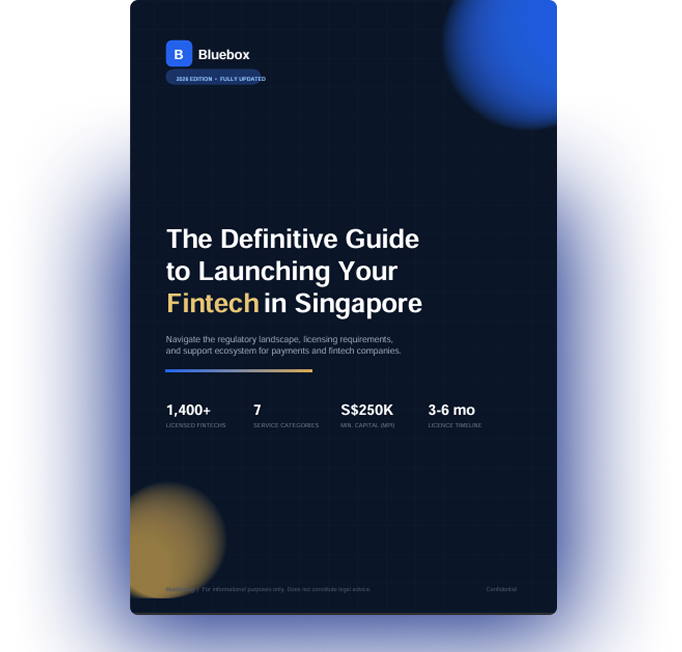
The Essential Guide to Launching a Fintech in Singapore
A complete overview of Singapore’s fintech regulations, licensing, and support ecosystem.
Fill out the details to get a copy.
What’s Inside
Your Roadmap to Singapore
This guide is structured to take you from understanding Singapore’s financial landscape all the way through to post-license operations and ongoing compliance.
Why Singapore?
Set up, manage and administer your entities.
Regulatory Architecture
Overview of laws governing financial services
The Payment Services Act
History, scope, and what it covers today
7 Payment Service Categories
Identify which services your business triggers
License Types & Thresholds
MC, SPI, MPI — choosing the right License
Application Checklist
Step-by-step preparation guide
Why Singapore?
Set up, manage and administer your entities.
Why Singapore?
Set up, manage and administer your entities.
Chapter 01
Why Singapore Is the World’s Fintech Launchpad
Singapore has deliberately positioned itself as the gateway to Asia’s US$3 trillion payments market. Here’s why global fintech choose to build here first.
Stable, Transparent Regulation
The Monetary Authority of Singapore (MAS) is globally respected for its balanced approach — fostering innovation while maintaining robust consumer protections and financial stability. Rules are clear, published, and consistently enforced.
Gateway to ASEAN & Beyond
Positioned at the crossroads of Asia-Pacific, Singapore provides seamless access to Southeast Asia’s 680 million consumers and the broader Indo-Pacific corridor. Extensive bilateral and multilateral trade agreements lower barriers to expansion.
Deep Talent Pool
A world-class education system, targeted immigration policies for tech talent, and a thriving startup culture mean you can build your team quickly. Programmers like Tech@SG further accelerate access to specialized foreign professionals.
Leading Digital Infrastructure
Singapore’s real-time payment rails (PayNow, FAST), national digital identity (Singpass), and open banking frameworks make it one of the most connected financial ecosystems globally — an ideal sandbox for new payment products.
Launch Your Fintech in Sigapore With Confidence
Get the complete breakdown of licensing, compliance, regulations, and market-entry requirements for fintech companies in Singapore.
Chapter 02
Singapore’s Financial Regulatory Architecture
The Payment Services Act is the primary legislation for payment companies, but it sits within a broader regulatory framework. Understanding the landscape prevents costly missteps.
Primary for Payments
Payment Services Act 2019
Covers account issuance, e-money, money transfers, merchant acquisition, money-changing, and digital payment token (DPT) services. This guide’s main focus.
Capital Markets
Securities and Futures Act 2001
Governs organized markets, broker-dealers, fund managers, and custody of capital markets products. Relevant if your tokens qualify as securities or if you operate an exchange.
Advisory
Financial Advisers Act 2001
Applies to those providing financial advice on investment products or arranging life insurance policies. Robo-advisory platforms may trigger this.
banking
Banking Act 1970
Covers deposit-taking, banking business, and issuance of credit and charge cards. Digital banks and neobanks with deposit-taking functions fall here.
Insurance
Insurance Act 1966
Governs life and general insurance business, including insurance agents and brokers. Insurtech companies should consider this alongside the PS Act.
Commodities
Commodity Trading Act 1992
Regulates commodity trading. Certain digital tokens may be classified as commodities depending on their characteristics and use cases.
Key takeaway
If your product touches multiple domains — for example, a platform offering both token trading and financial advice — you may require licences under more than one Act. Seek specialist legal counsel early to map your full regulatory footprint.
Chapter 03
The Payment Services Act: From Fragmented Rules to Unified Framework
Singapore’s payments regulation has evolved significantly. Understanding this history helps you appreciate the current framework’s logic and direction of travel.
Before 2020, payments regulation in Singapore was fragmented across multiple statutes. Money-changers and remittance providers were licensed under the Money-changing and Remittance Businesses Act (MCRBA), while certain stored value facilities fell under the Payment Systems (Oversight) Act (PS(O)A).
Newer payment models like e-wallets and cryptocurrency services existed in regulatory gaps.
Recognising these gaps, MAS undertook a comprehensive consultation process beginning in 2017 that led to the Payment Services Act 2019 (PS Act), which came into force on 28 January 2020. The PS Act consolidated all payment services regulation under a single, activity-based framework.
The framework was further refined with amendments that took effect on 4 April 2024, expanding regulatory scope and strengthening consumer protections — particularly around digital payment token services.
Pre-2020
Fragmented Regime
MCRBA covered money-changers and remittance providers. PS(O)A covered certain stored value facilities and designated systemically important payment systems.
Nov 2017
Consultation Begins
MAS published its Consultation Paper on the proposed Payment Services Bill, seeking to unify and expand the scope of regulated payment services.
Jan 2020
PS Act Comes Into Force
The new unified framework consolidated payment regulations, repealed MCRBA and PS(O)A, and introduced seven categories of payment services.
Apr 2024
Major Amendments
Enhanced consumer protection, expanded DPT regulation, and strengthened requirements for custody and transmission of digital assets.
Your Complete Fintech Launch Blueprint for Singapore
Everything founders need to navigate MAS regulations, payment licenses, compliance, and operational setup.
Chapter 04
The Seven Categories of Regulated Payment Services
The PS Act defines seven distinct payment services. Your business model may trigger one or several of these categories. Understanding them is the critical first step in your licensing journey.
Account Issuance
Issuing payment accounts to users that hold funds or facilitate transactions — common for e-wallet and stored value facility providers.
E-Money Issuance
Issuing electronically stored monetary value denominated in a fiat currency, purchased by users on a pre-paid basis for making payment transactions.
Domestic Money Transfer
Transferring money from one person or entity to another within Singapore, whether initiated by the payer or on behalf of the payee.
Cross-Border Money Transfer
Inbound or outbound money transfers where either the sender or recipient is located outside Singapore — core to remittance businesses.
Merchant Acquisition
Processing payment transactions on behalf of merchants, enabling them to accept payment instruments from customers.
Money-Changing
Buying or selling foreign currency notes and coins. This is the most traditional service, historically regulated under the MCRBA.
Digital Payment Token (DPT)
Covering five sub-categories: dealing in DPTs, facilitating exchange, inducement/brokerage, custody, and transmission of digital payment tokens.
Common business model triggers
An E-wallet provider often triggers account issuance, E-money issuance, and domestic/cross-border money transfer. A cryptocurrency exchange typically triggers multiple DPT sub-categories. A remittance platform triggers domestic and cross-border money transfer. Always map your full product offering to determine the complete set of applicable services.
Chapter 05
Choosing the Right License
The PS Act offers three license types with progressively stricter requirements. Your choice depends on the type of services and your transaction volumes.
Exclusions
Certain activities are carved out of PS Act regulation entirely. If you qualify for an exclusion — for example, transactions between related corporations, provision of pure technical infrastructure without handling funds, or certain loyalty point programmes — you are not subject to licensing or ongoing compliance obligations. However, incorrectly relying on an exclusion carries serious enforcement risk.
Exemptions
Separate from exclusions, certain exemptions are available under the Payment Services Regulations 2019 (PSR). If you fall within an exemption, you may not need a licence but will typically still be subject to certain ongoing compliance obligations. The distinction matters: exemptions remove the licensing requirement, not all regulatory obligations.
Bluebox recommendation
Always obtain formal legal advice before relying on any exclusion or exemption. If the conditions are not met at any point, you may be operating in breach of licensing requirements — which carries criminal penalties.
Everything You Need to Launch a Fintech in Singapore
Avoid costly compliance mistakes with a practical guide covering licensing, regulations, and setup requirements.
Chapter 06
Your Application Preparation Checklist
Preparing a PS Act license application is a substantial undertaking. Here’s a comprehensive checklist of what you’ll need to have ready before submitting your application through MAS’ online portal.
Corporate Setup & Governance
Financial & Business Documentation
Legal & Compliance Preparation
Additional Requirements for DPT Service Providers
Application fees:
Fees are payable upon submission and vary by license type. Refer to the Schedule of the Payment Services Regulations 2019 for current fee amounts. MAS also publishes detailed licensing guidelines (PS-G01) that should be thoroughly reviewed.
Chapter 07
Life After Licensing: Ongoing Compliance
Obtaining your licence is just the beginning. PS Act licensees face a comprehensive set of ongoing obligations. Here’s what you need to stay on top of.
Core Obligations
Maintain prescribed base capital (S$100K for SPIL, S$250K for MPIL) plus adequate buffer for 6–12 months of operating expenses
Maintain security deposit with MAS (S$100K or S$200K, as cash deposit or bank guarantee)
Pay annual license fees as prescribed by MAS
Comply with DPT safeguarding requirements (DPT providers)
Submit regulatory returns on schedule
Keep CEO, executive directors, and senior management employed full-time and Singapore-based
Do I need to posDesignate a qualified compliance officer at management level (must be in-house for DPT providers)t on MyCareersFuture?
Comply with fiat currency safeguarding requirements
Report suspicious activities and fraud incidents
Chapter 08
Grants, Schemes & the Singapore Ecosystem
Singapore offers an unusually rich support ecosystem for fintechs. From direct grants to talent facilitation and innovation programmes, here’s what’s available.
Capability Development
The Productivity Solutions Grant (PSG) helps local SMEs adopt IT solutions. The Enterprise Development Grant (EDG) supports broader business upgrading, innovation, and growth. The Enterprise Compute Initiative provides cloud credits and consultancy for AI transformation projects.
Talent & Manpower
The Global Ready Talent (GRT) Programme builds pipelines of internationally-minded young professionals. The Technology for Enterprise Capability Upgrading (T-Up) helps local firms build R&D capabilities. Tech@SG facilitates employment pass applications for fast-growing tech companies.
Financing
The Enterprise Financing Scheme (EFS) is a government-assisted programme helping local enterprises access financing across all growth stages — from early-stage working capital to expansion loans and trade financing.
Market Access
The Market Readiness Assistance Grant (MRA) funds overseas expansion. The Global Innovation Alliance (GIA) connects Singapore-based startups with international innovation hubs. The IHQ Development & Expansion Incentive supports companies setting up regional headquarters.
Startup Programmes
Stage ONE provides one-stop support for startups. The EntrePass visa enables foreign founders to establish innovative ventures. The Startup SG ecosystem offers mentoring, equity co-investment, and accelerator partnerships.
MAS Innovation Schemes
The Financial Sector Technology and Innovation Scheme (FSTI 3.0) covers seven domains including AI, RegTech, ESG FinTech, and Quantum Technology. BLOOM strengthens digital asset infrastructure. PathFin.ai and BuildFin.ai foster AI adoption in financial services.

Your Partner in Singapore Fintech Strategy
Bluebox helps fintech companies navigate Singapore’s regulatory landscape with clarity and confidence. From initial market assessment to licensing support and ongoing compliance advisory, we provide the strategic guidance and practical expertise you need to build successfully in one of the world’s most dynamic financial centres.
Get the Full Guide
Download the Complete Singapore Fintech Playbook
Get our 40-page PDF with detailed checklists, timeline templates, cost breakdowns, and direct links to every MAS form and guideline you’ll need.
Fill out the details to get a copy.
By downloading, you agree to receive occasional updates from Bluebox. Unsubscribe any time.